The 10 Psychological Mechanisms Behind Uni’s Talent Quiz
A stage-by-stage teardown of the theuni.io/f/talents-v3 quiz funnel, analyzed through ten lenses from persuasion theory, behavioral economics, and parental decision-making research. Each lens is named and tied to the specific screen that activates it.
The Premise
Uni runs a quiz funnel for parents that promises to identify their child’s “unique talents” and produce a personalized growth plan. As of May 2026 the funnel runs ~5,800 visits/month and is the destination for 148 of 546 active Meta ad creatives (27% of the brand’s ad spend on a single landing page) — one of four parallel funnels Uni runs against the same product. It ends in a 3-tier subscription paywall: a $0.99/day 7-day trial, a $0.50/day 4-week plan, and a $0.41/day 12-week plan, each anchored against a struck-through “original” price.
The mechanical question — does the funnel convert? — isn’t the interesting one. The interesting question is structural: which psychological mechanisms is the funnel recruiting at each screen, and how do they interlock? Uni’s talents-v3 funnel is unusually deliberate. It activates roughly ten distinct lenses across the quiz body, reveal, and paywall — many of them aimed not at the buyer’s wallet but at the buyer’s identity as a parent.
The walkthrough is organized by funnel stage — hook, quiz body, reveal, paywall, downsells — with each stage’s screens analyzed in the order a real parent encounters them.
Stage 1The Hook
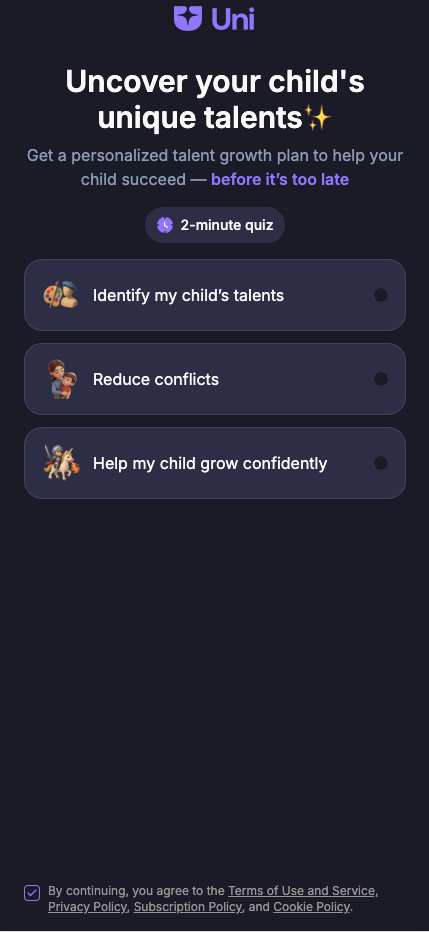
The opening screen has to do three things simultaneously: get a parent who clicked an Instagram Stories ad to invest two minutes, position the next ten minutes as time spent on their child rather than on a brand, and plant a curiosity gap large enough to pull them through 30 questions.
The hook’s most psychologically expensive word is “before it’s too late.” The phrase imports two separate moves at once. It activates loss aversion (the loss being framed is the child’s un-developed potential), and it bridges to a future self that doesn’t exist yet (the future child whose talents will or won’t have been identified). The parent isn’t deciding whether to buy an app — the parent is deciding whether to be the parent who acts before a developmental window closes.
This is structurally different from most subscription hooks, which lead with gains (“unlock potential,” “discover talents”). Uni leads with the gain framing in the headline (“Uncover your child’s unique talents”) but inserts the loss framing immediately below it. The two framings stack: the gain attracts attention; the loss closes the click.
The three options on the hook — “Identify my child’s talents,” “Reduce conflicts,” “Help my child grow confidently” — are all framed at high construal level. None of them mention an app, a quiz, a subscription, or a price. They are identity-level why statements that any engaged parent can recognize as their own. The construal arc that follows will walk the parent from this abstract level (Q1: identity) down to the concrete one (Q27: date of birth, Q43: pricing tier) over the course of the funnel.
A funnel that opens with mechanics or feasibility (“Get the Uni app for $0.50/day”) would mis-match construal level to stage. Uni does not make that mistake. The parent commits to the abstract goal first; the feasibility question only appears once the parent has already done ten minutes of identity-level work.
Stage 2The Quiz Body
The Uni quiz runs roughly 30 numbered questions plus several unnumbered validation interstitials, with a top progress bar segmented into four arcs. The questions are not really gathering data — the product makes confident-sounding personalized claims about every child regardless of input. The questions exist to do psychological work on the parent. Three lenses explain most of that work.
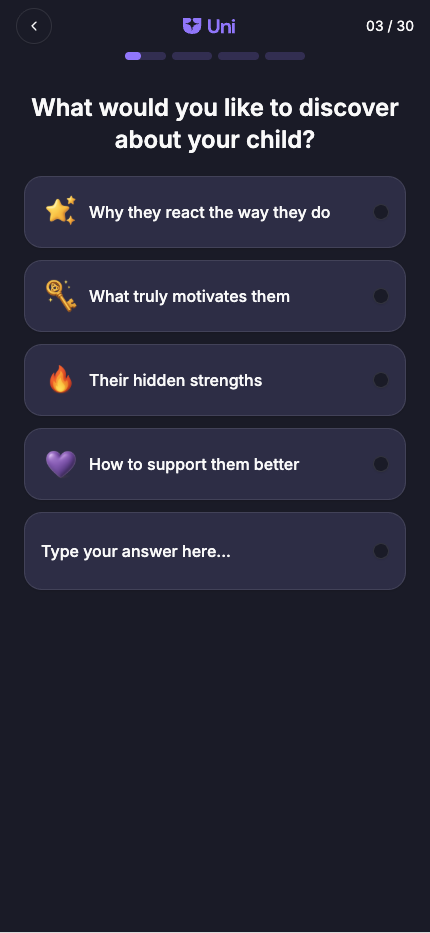
This is, arguably, the deepest mechanism the Uni quiz recruits. By the time the parent has answered Q20 about their child’s motivations, hidden strengths, and emotional patterns, they have performed twenty observable acts of caring carefully about their child’s inner life. Self-Perception predicts that, without much conscious deliberation, the parent will infer from this behavior: I am the kind of parent who takes this seriously.
The quiz does not need to convince the parent that Uni’s product matches their values. The quiz is staging a performance in which the parent generates evidence of those values, observes themselves doing it, and updates their self-concept accordingly. By the paywall, the parent is not buying a parenting app — they are buying a product consistent with the parent they have just spent ten minutes acting like.
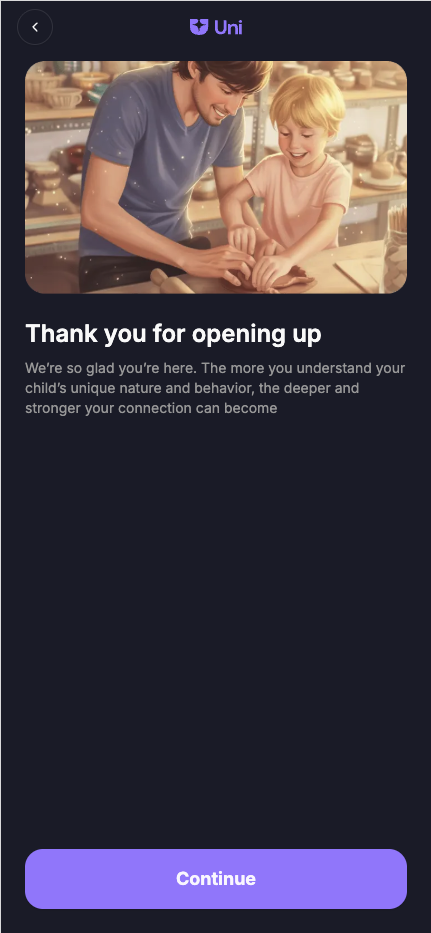
The mid-quiz interstitial — a warm illustration of a father and child kneading dough, captioned “Thank you for opening up” — is doing affective rather than informational work. The interstitial doesn’t advance the quiz; it punctuates it. By inserting affect peaks between blocks of cognitive effort, Uni keeps the emotional register of the funnel warm enough that the parent doesn’t notice the cognitive load.
The Uni mascot in the header is doing Mere Exposure work. It appears on every screen for thirty steps. By the time it sits next to a $38.95/month price, it will feel familiar — and familiarity, the literature shows, generates trust even when the source of familiarity is the brand’s own funnel. The illustrated kids on Q1 reappear thematically on the reveal, on the paywall, and on the downsells.
The top progress bar (“03/30… 27/30…”) is not a UX flourish. It is a deliberate sunk-cost visualization. Each tick is a small explicit reminder that effort has been spent and that abandoning means losing it. The progress bar is the mechanism by which the cognitive cost of the quiz becomes the conversion engine of the paywall.
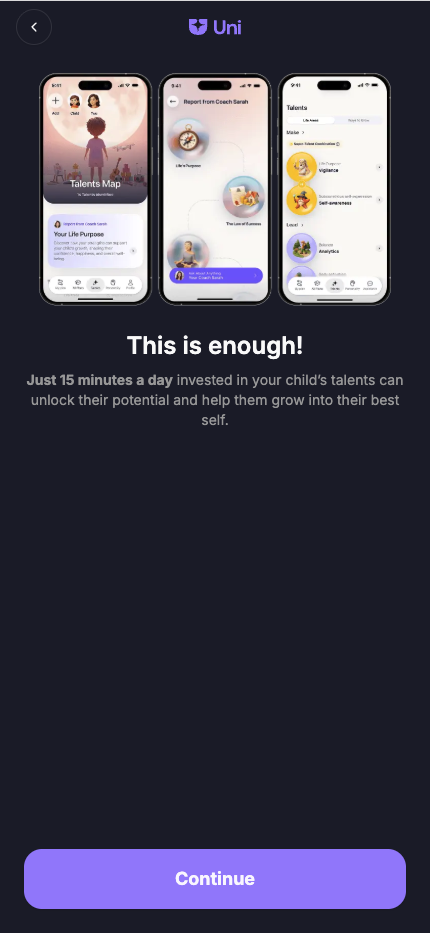
The Goal Gradient Effect explains what happens at the end: drop-off rates should fall, not rise, as the parent approaches the reveal. Walking away from Q27 means losing 27 questions of investment in exchange for nothing. Walking away from Q3 only costs three. This is also the structural reason late-quiz interstitials (Q28–30) introduce the product preview — the parent is far enough into the gradient that they will absorb mild monetization signals (“15 minutes a day”) without bailing.
Stage 3The Reveal
Between the last quiz question and the paywall, Uni inserts a sequence of theatrical reveal screens. The most important of them is the “Your child has 24 unique talents” mandala — a single screen carrying the emotional weight of the entire ten-minute investment. This is performance, and the performance is doing two things at once.


“Your child has 24 unique talents” is a textbook Barnum statement. It is true of nearly every child reading age — the taxonomy is structured so the per-talent description fits any child whose parent took a quiz about them. The six named talent clusters (Presence, Productivity, Caring, Friendship, Will, Reflection) are broad enough to cover the entire space of childhood behaviors. Whichever combination the algorithm assigns, the parent will recognize their child.
This lens is analytically uncomfortable because it is mechanically the same trick a school-counselor personality test uses. But the relevant question for funnel analysis is not whether the personalization is real — it is whether the parent experiences it as personal. The Forer effect predicts they will, and the entire premise of the “personalized growth plan” paywall depends on it being true. The named-talents framing also handles a separate problem: it gives the parent specific language they can use about their own child after the funnel, which seeds organic word-of-mouth at zero marginal cost.
The reveal is the funnel’s most psychologically expensive screen for the parent. They have been carrying the gap (“what are my child’s talents?”) for ten minutes. The mandala layout, the named talents, and the “Your talent map is ready” follow-on signal that the answer has been produced — but the actual content of the growth plan, the actual exercises, the actual coach — is held back. The parent has been shown enough to verify the answer exists. The full answer is on the other side of the paywall.
This is not coincidence. The behavioral economics literature on choice timing is consistent: friction is most easily absorbed when it stands between the user and an outcome they have already psychologically committed to. The paywall is not interrupting the parent’s journey — it is positioned as the final step of resolution.
The mandala reveal is the funnel’s engineered emotional peak. It is the only screen with no scrolling, no buttons except “Continue,” and a centered visual artifact that exists for no reason except to be remembered. The personalized talent profile that follows is the engineered ending peak for the pre-purchase experience — designed to be the screenshot a parent might send to a co-parent or post in a friend group. Most quiz screens in this funnel are forgettable on purpose. These two are not.
Stage 4The Paywall
The Uni paywall is delivered across multiple screens, not one, and the order matters. The parent first sees a “61% Discount” ticket-styled card with a wrapped-gift emoji. Only after they tap Continue do they see the sales page with social proof, the talent-map summary, the pricing tiers, and the auto-renewal disclosure. This sequence is the most analytically dense part of the funnel.
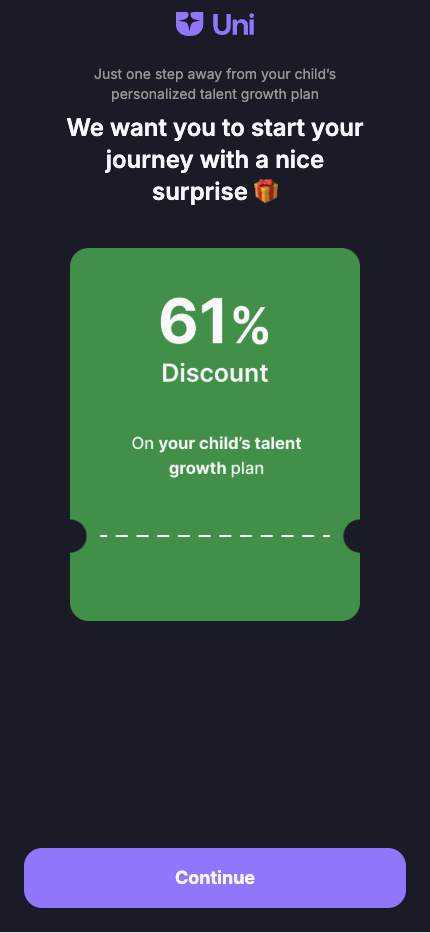

The 61% discount card is a near-textbook Door-in-the-Face setup, executed in microcosm before the prices have even been shown. The card establishes a referent: “The full price exists, and the brand is choosing to give you a 61% concession.” The parent has not yet seen the original price, the discounted price, or what they are getting. They have only been told that a generous gesture is being made to them, specifically, as a thank-you for opening up about their child.
The psychological accounting is precise. Reciprocity predicts the parent will feel a small but real obligation to consider the offer on its merits, rather than dismissing it as “another subscription.” The screen also handles a separate problem: it pre-loads the strikethrough prices on the next screen as already-negotiated rather than as new claims. When the parent then sees $17.77 struck through to $6.93, it doesn’t feel like a sales tactic — it feels like the receipt for the gift they were just told about.
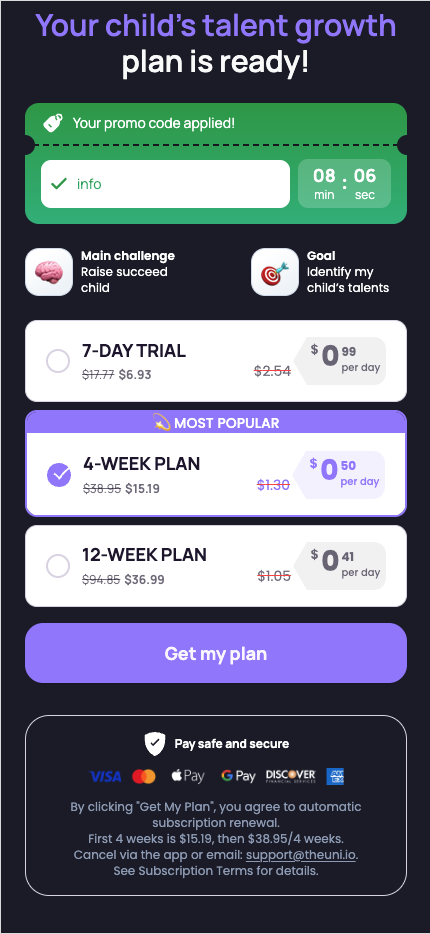
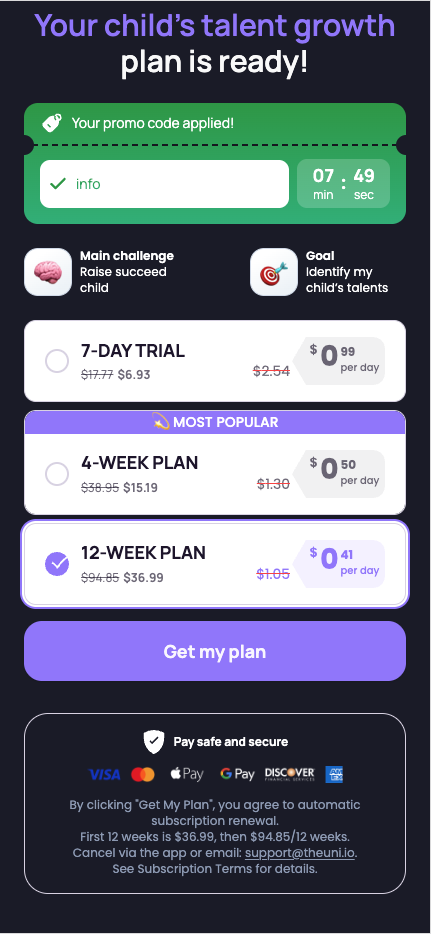
The pricing screen is structurally the most carefully engineered screen in the funnel. Three tiers, two anchors, one defaulted target. The struck-through prices ($17.77, $38.95, $94.85) function as anchors: they set the reference points against which the “real” prices ($6.93, $15.19, $36.99) are evaluated. The original prices never have to be paid by anyone; their only job is to be the numbers the discounted prices are measured against.
The three-tier structure also runs a textbook decoy. The 7-Day Trial ($6.93) is the low-friction entry; the 12-Week Plan ($36.99) is the price ceiling; the 4-Week Plan is pre-selected with a “Most Popular” badge. The 7-Day Trial primes “you don’t have to commit much”; the 12-Week Plan primes “serious parents pay more.” The 4-Week Plan sits at the cognitive sweet spot between them — cheaper per day than the trial ($0.50 vs $0.99), shorter than the long commitment, with a daily framing that makes the monthly cost feel like a coffee.
The daily-price framing ($0.99/d, $0.50/d, $0.41/d) is the second-most-important move on this screen. It converts a $38.95 monthly commitment into a $0.50 daily commitment — the same money, but evaluated in a different mental account. Thaler’s work on Mental Accounting predicts the daily framing will reduce sticker resistance even for parents who are unwilling to make the same monthly commitment in absolute terms.
The countdown timer at the top of the pricing screen (“08:37” min:sec) is the funnel’s only overtly aggressive persuasion element. It is doing scarcity work — the discount is framed as time-bound, even though the timer resets on every page load — but the timer is also doing peripheral work that matters more. It is creating a soft urgency floor that makes the parent commit now, rather than putting the decision off until tonight or tomorrow, by which time the emotional residue of the reveal has decayed.
The 4-Week Plan’s pre-selection (filled radio button, “Most Popular” badge, dotted-outlined card) is a status-quo move. Removing the 4-Week Plan’s selection requires an active act of opting into something else. The structural effect mirrors what Sunstein and Thaler showed in retirement contributions: pre-selected defaults attract dramatically higher uptake than identical opt-in options, even when the user can change them in two taps.
Stage 5The Downsells
If the parent declines or fails the initial paywall, Uni runs a payment-recovery sequence. The downsells are the most visibly cost-conscious part of the funnel and reveal the brand’s actual price-elasticity floor — not the strikethrough numbers shown on the paywall, but the prices Uni will actually accept when the alternative is zero.

The PDF artifact accompanying Uni’s downsell flow is titled “Update Payment to Unlock Your Calm Parenting Tools” — explicit confirmation that the downsell sequence is also doing failed-charge recovery, not just price-objection handling. This is structurally the most defensible piece of revenue in the funnel: the user has already crossed the payment Rubicon, and the cost of an extra recovery touch is essentially zero.
The Composite Picture
What this funnel does extraordinarily well
Uni’s talents-v3 funnel does not rely on any single mechanism. Removing the progress bar wouldn’t kill it; removing the strikethroughs wouldn’t kill it; removing the discount card wouldn’t kill it. Each individual lens contributes a fraction of the conversion lift. The funnel is robust because the mechanisms layer additively, and because the visual register (warm illustrations, soft purple, no salesy register) keeps the parent’s Persuasion Knowledge dormant throughout. A parent clicking through this funnel is not being sold ten things in sequence — they are having a coherent ten-minute experience about their child that happens to end with a price.
The funnel’s most underappreciated property is that the buyer never feels like the target. The product is for the child; the quiz is about the child; the talents belong to the child; the growth plan describes the child. The parent is repeatedly cast in the role of investigator, not buyer. By the time the price appears, the parent’s identity has been recruited so thoroughly that declining the offer would mean declining their own role in their child’s development, not declining a subscription.
Where it leaves money on the table
Two structural weaknesses stand out. First, the funnel under-uses Authority. The sales page mentions “Trusted by parents worldwide” and shows brief testimonials, but there is no credentialed expert framing — no developmental psychologist, no pediatrician, no “developed in partnership with X institute” line. Uni has the audience scale to credibly cite real child-development experts; doing so would harden the legitimacy of the talent-map claims and likely reduce day-3 churn. Second, the funnel uses Descriptive Social Proof (“Most Popular” on the 4-Week tier) but never pivots to Injunctive Social Proof — the “what parents like you do” variant that the literature consistently shows is more binding once the user has been segmented by quiz answers (which Uni does by Q5). A “87% of parents whose child shares your child’s top talent continued past the trial” line on the paywall would cost nothing and likely move the needle.
What a contrarian designer would change
The 61% discount card is brilliant on the day-1 conversion axis but raises a real question on the day-30 retention axis. A parent who selected the 4-Week Plan because the 61%-off framing made it feel free may experience more cognitive dissonance at the $38.95/4-week renewal than a parent who selected the 12-Week Plan voluntarily. The funnel might earn more LTV from the 4-Week cohort if the post-purchase activation flow explicitly addressed the gap (“your introductory rate was $15.19; your full subscription is $38.95/4 weeks”), rather than treating all paid users as homogeneous. The countdown timer also deserves a second look — the literature is mixed on whether countdown timers help conversion in long-consideration verticals like parenting subscriptions. They reliably help on impulse purchases. Parenting is not an impulse purchase.
What Operators Can Steal
The most replicable move in Uni’s funnel is structural: the buyer is positioned as investigating a third party (their child) for the entire ten-minute pre-purchase experience. The price-objection problem evaporates because by the time the price appears, the buyer’s identity is tied to the investigation, not to the purchase. This works in any vertical where there’s a credible third party to investigate — pets, partners, parents, employees, customers.
“Before it’s too late” on the hook reframes the choice from “spend $0.50/day” to “don’t fail to act.” The literature on Loss Aversion is unambiguous: losses are weighted ~2.5x more heavily than equivalent gains. Most subscription funnels lead with gain framing. The ones that convert lead with loss framing wrapped inside gain framing — gain in the headline, loss in the subhead.
The 61% discount card is the operator’s most transplantable move. By framing the discount as a gift before any price has been shown, Uni pre-loads the strikethrough prices on the next screen as already-negotiated. The same prices, shown without the discount card first, would feel like sales tactics. With it, they feel like a receipt.
$0.50/day is the same money as $15.19/4 weeks, but it is evaluated against a different mental account. Mental Accounting (Thaler, 1985) predicts the daily framing will reduce sticker resistance even for parents who would decline the same money in monthly terms. Show both, but make the daily price the visually dominant one.
Most screens in the Uni quiz are forgettable on purpose. The exception is the “24 unique talents” mandala — the engineered peak — and the personalized talent-map screen — the engineered ending peak. Stop optimizing every screen equally; identify the two screens whose memory will define the experience and design those. A parent who screenshots their reveal and sends it to their partner is a parent who has already converted.
By the Numbers
Want the full funnel breakdown?
See every quiz step, paywall variant, ad creative, and downsell screen for Uni — plus the same lens analysis applied across 250+ web2app funnels — inside the Consumer App Index.